

Overview
A clean automated scan report is often the most dangerous document in your security stack because it creates a false sense of safety that sophisticated adversaries exploit. You likely recognize that while your provider secures the infrastructure, the burden of data protection remains yours, especially since 82% of breaches in 2024 involved cloud-based data. Securing these environments requires high-level cloud penetration testing uk that prioritizes human intelligence over simple automation to uncover deep-seated architectural flaws.
We agree that your team needs actionable insights rather than vague, low-cost reporting that fails to satisfy regulators. This 2026 buyer’s guide provides a structured framework for UK organisations to evaluate and procure cloud security assurance that aligns with DORA and NIS2 standards. You’ll learn how to move beyond static testing toward a continuous security model, utilizing the Pentesys Portal to manage a clear remediation roadmap and gain absolute confidence in your cloud controls.
The State of Cloud Security in the UK: Why Traditional Testing Fails
Cloud penetration testing uk has evolved from a periodic compliance checkbox into a fundamental requirement for operational resilience. This process involves an authorised adversarial assessment of cloud-hosted environments, designed to identify and exploit vulnerabilities before malicious actors can. Unlike legacy on-premise infrastructure, modern cloud architectures are dynamic, ephemeral, and governed by the shared responsibility model. Traditional testing methods often focus on static perimeters and physical hardware, which fails to capture the complexities of serverless functions, container orchestration, and identity-based access controls inherent in platforms like AWS, Azure, and Google Cloud.
By 2026, the UK threat landscape is dominated by sophisticated identity-based attacks and supply chain compromises. While zero-day exploits often grab headlines, data from the previous year shows that 82% of cloud breaches originated from simple misconfigurations or overly permissive access rights. These “low-hanging fruit” vulnerabilities remain the primary vector for data exfiltration because cloud environments change so rapidly. Consequently, UK enterprises are moving away from static, annual audits. They are adopting a model of continuous security assurance to maintain a robust cloud computing security posture in an environment where a single configuration change can expose an entire database to the public internet in seconds.
The Evolving UK Regulatory Landscape
UK organisations face a tightening web of compliance requirements that demand more than just passive scanning. The implementation of the Digital Operational Resilience Act (DORA) and the NIS2 Directive has set a high bar for financial services and critical infrastructure providers operating within or alongside the EU. These regulations, alongside the NCSC Cyber Assessment Framework (CAF), demand evidence of proactive risk management. Offensive security testing is now a prerequisite for meeting UK cyber insurance mandates. Most insurers require documented proof of regular, human-led cloud penetration testing uk to maintain coverage and manage premium costs effectively.
The Illusion of Automated Security
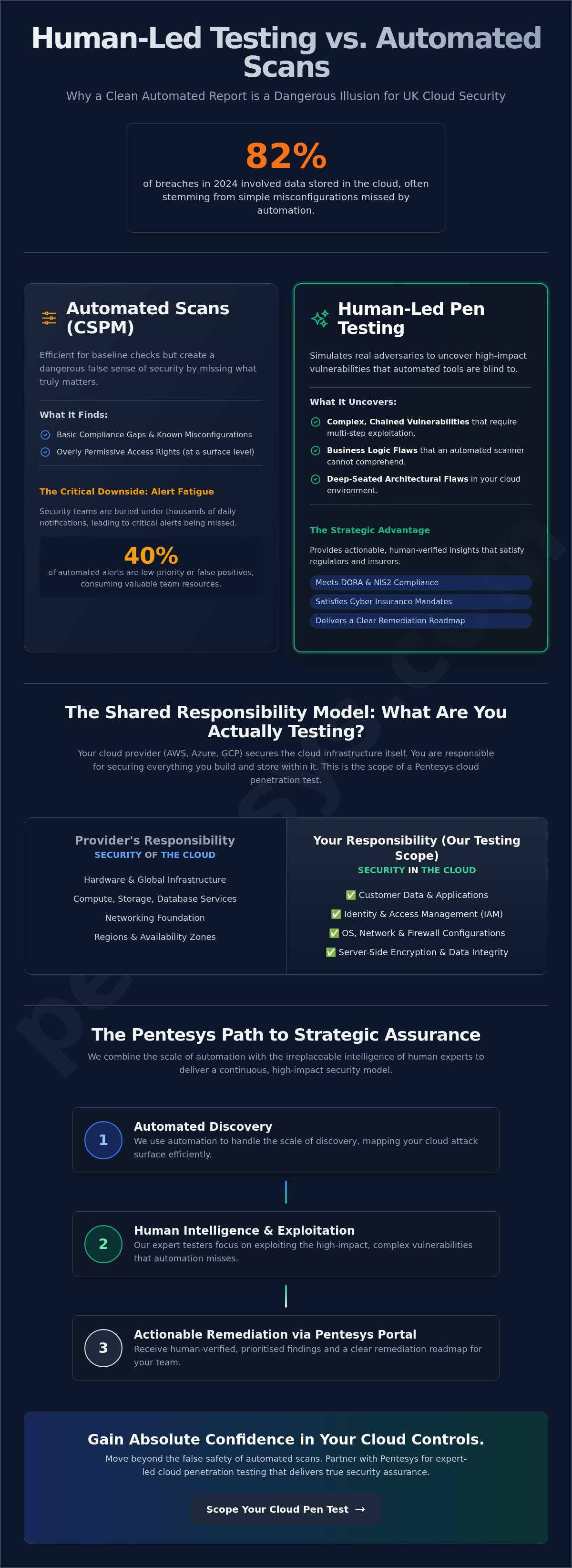
Many UK security teams rely heavily on Cloud Security Posture Management (CSPM) tools to monitor their environments. While these automated solutions are efficient at identifying basic compliance gaps, they often miss complex logic flaws that a human adversary would exploit. This reliance creates a dangerous “Alert Fatigue” problem. Security teams are frequently buried under thousands of notifications daily, with industry data suggesting up to 40% of these are low-priority or false positives. The Pentesys philosophy addresses this by using automation to handle the scale of discovery, while our human experts focus on exploiting high-impact vulnerabilities. We provide prioritised, human-verified insights through the Pentesys Portal, ensuring your team focuses on remediation that actually moves the needle on risk.
The Shared Responsibility Model: What Are You Actually Testing?
Effective cloud security begins with a clear understanding of where your provider’s duty ends and your obligation starts. While Amazon Web Services (AWS), Microsoft Azure, and Google Cloud Platform (GCP) provide a resilient foundation, they only secure the “Cloud” itself. You remain responsible for everything you put “in” the cloud. This distinction is the bedrock of cloud penetration testing uk, ensuring that your specific configurations, code, and data remain resilient against modern threats.
By 2026, the legal landscape for testing has matured. Most major providers no longer require formal notification for standard vulnerability assessments. However, high-impact adversary simulations or tests involving DDoS components still necessitate explicit technical permissions to avoid triggering automated account suspensions. Our team aligns every engagement with the latest NCSC cloud security guidance, ensuring your testing program meets UK national standards for architectural rigour.
We categorise cloud assurance into three distinct pillars: Infrastructure, Identity, and Data. Infrastructure testing examines the virtual network and compute instances. Identity testing focuses on the permissions that govern access. Data testing ensures the confidentiality of the information stored within these systems. This structured approach allows Pentesys to provide a comprehensive view of your security posture through the Pentesys Portal, where you can track progress in real-time.
Identity and Access Management (IAM) Vulnerabilities
Identity has replaced the traditional network perimeter. In modern cloud environments, a single compromised set of credentials can grant an attacker more access than a physical breach of a data centre. A common pitfall for UK enterprises is the persistence of over-privileged service accounts. Statistics from 2024 indicate that 74% of all cloud breaches involve the abuse of privileged credentials. Pentesys testers simulate credential theft to identify how an attacker could move laterally from a low-level account to a global administrator role. We focus on legacy APIs that lack Multi-Factor Authentication (MFA), providing clear remediation guidance to close these gaps.
Storage and Database Misconfigurations
Misconfigured storage remains a primary vector for data leaks. Publicly accessible S3 buckets or unencrypted Azure Blobs often stem from a lack of visibility rather than intent. Within complex multi-cloud environments, data egress vulnerabilities can lead to significant financial and reputational damage. Ensuring compliance with UK GDPR requires more than just encryption at rest; it demands rigorous testing of the data layer to prevent unauthorised exfiltration. Our human-led testing identifies these subtle misconfigurations that automated tools often miss. If you are unsure if your storage tiers are fully protected, you can request a scoping call to discuss a tailored security assessment.
Human-Led Testing vs. Automated Scans: A Comparison for Decision Makers
Decision makers often mistake vulnerability scanning for a complete security assessment. Automated tools are essential for baseline security hygiene; they catch known CVEs and common misconfigurations. However, effective cloud penetration testing uk requires a shift from simple hygiene to true resilience. Pentesys consultants focus on human-led testing to identify “chained” vulnerabilities. These occur when a tester combines multiple low-risk issues to create a high-impact breach, a process that automated algorithms consistently fail to replicate.
Context changes everything in cloud security. A tool might label a misconfigured storage bucket as a “Medium” risk based on generic parameters. If that bucket contains sensitive UK customer data or proprietary intellectual property, our consultants reclassify it as “Critical.” We provide this clarity through the Pentesys Portal, which translates technical findings into actionable business intelligence for stakeholders. This ensures your security budget is spent on fixing flaws that actually threaten your operations.
The Limitations of Tooling in 2026
By 2026, AI-driven scanners have become ubiquitous, yet they struggle with custom business logic and complex API workflows. Scanners lack the ability to understand the intent behind a specific cloud architecture. This limitation results in a high volume of false positives that drain internal resources. We save UK IT teams significant time by providing only manually verified results, ensuring your engineers focus on real threats rather than tool-generated noise.
Adversarial Intuition is the key differentiator in high-assurance testing, representing the human ability to anticipate and exploit logical flaws that fall outside the parameters of programmed code. While a tool follows a script, a Pentesys tester follows the path of least resistance, much like a real-world attacker would.
The Pentesys Methodology: Intelligence Over Algorithms
Our approach integrates Cloud penetration testing best practices with a rigorous, human-centric framework. We don’t just point at problems; we demonstrate the impact. Our methodology follows a logical progression:
This structured process ensures we meet the requirements for CREST accredited penetration testing UK organizations need to satisfy both insurers and regulators. We prioritize transparency, using the Pentesys Portal as a central hub where technical teams and executives can track progress and remediation status in real time. It’s a partnership-driven model that replaces automated uncertainty with professional assurance.
- Reconnaissance: We map your cloud footprint, identifying exposed assets and forgotten shadow IT.
- Exploitation: Our testers attempt to bypass security controls, mimicking the tactics used by Advanced Persistent Threats (APTs).
- Post-Exploitation: We analyze how far an attacker could move laterally through your environment once they’ve gained an initial foothold.
Procurement Guide: How to Scope Your Cloud Pen Test
Effective scoping is the difference between a superficial scan and a robust security posture. When commissioning cloud penetration testing uk, you must define environment boundaries to ensure the assessment provides genuine assurance. Start by categorizing your assets. While testing staging environments reduces the risk of service disruption, testing production environments is essential to identify misconfigurations that actually put live data at risk. The 2024 Thales Cloud Security Study found that 44% of organisations experienced a cloud data breach, often due to production-level oversights.
Testing depth determines the level of insight you’ll receive. Black-box testing simulates an external adversary with zero prior knowledge of your systems. White-box testing provides the consultant with full architectural access and credentials. For most UK enterprises, a grey-box approach is the most efficient. It allows testers to bypass simple discovery phases and focus on deep-tier vulnerabilities within the cloud fabric, providing a more comprehensive cloud penetration testing uk experience.
In the UK market, credentials provide the necessary benchmark for quality. CREST and CHECK certifications aren’t just badges; they’re evidence that the provider adheres to rigorous technical standards and ethical frameworks. Finally, evaluate the reporting output. A professional provider delivers more than a list of vulnerabilities. They provide actionable remediation guidance and strategic insights through a centralized platform like the Pentesys Portal, rather than a static, unhelpful PDF.
Scoping for Compliance: ISO 27001 and Beyond
Your scope must align with specific regulatory frameworks to satisfy auditors. For ISO 27001, focus on Annex A controls related to technical vulnerability management. If you handle payment data, your PCI DSS cloud security assessment must cover the entire Cardholder Data Environment (CDE). High-compliance sectors increasingly move away from annual checks toward continuous penetration testing to maintain a real-time security baseline against evolving threats.
Questions to Ask Your Potential Provider
Build a resilient cloud strategy with a partner who understands the UK regulatory landscape. Contact Pentesys today to begin your scoping assessment.
- Do you use permanent employees or sub-contractors? Pentesys relies on human expertise from in-house specialists to ensure accountability and consistency.
- How do you handle data residency and security? Ensure all testing data remains within the UK or EEA to comply with UK GDPR and local data protection laws.
- What is your process for re-testing and verifying remediations? A test is only complete once you’ve verified that fixes are effective. Ask if the provider includes a formal re-test in their standard engagement.
Pentesys: Delivering Strategic Cloud Assurance
Pentesys redefines the standard for cloud penetration testing uk by moving beyond the limitations of static, point-in-time reports. We provide a framework where security is a constant state of readiness rather than a yearly checklist. Our methodology integrates deep technical expertise with a strategic understanding of UK business risks, ensuring your cloud environment remains resilient against evolving threats. We don’t just identify flaws; we provide the roadmap to fix them.
The Pentesys Portal Advantage
The Pentesys Portal acts as the central hub for your entire security engagement. It centralises vulnerability management through a single, intuitive dashboard that replaces cumbersome spreadsheets and static documents. You gain real-time visibility into your security posture, seeing vulnerabilities as our consultants identify them. This transparency allows your internal teams to begin remediation work immediately, significantly reducing the window of opportunity for attackers.
We believe that high-quality security assurance requires a “Partnership, Not Project” mindset. Our consultants don’t just run automated scans. They conduct human-led adversary simulations that reflect the actual tactics used by modern threat actors. This human element is vital because cloud environments are complex. A script might miss a logical flaw in an IAM policy or a subtle misconfiguration in a Kubernetes cluster, but an expert consultant will find it. We prioritise long-term resilience over temporary fixes, helping you build a culture of security that scales with your business.
- Direct access to testing experts provides clear, actionable remediation guidance tailored to your specific stack.
- UK firms can track security improvements over time with historical data and trend analysis.
- The platform facilitates seamless communication between your developers and our security specialists, ensuring no finding is misunderstood.
Next Steps for Your Organisation
Securing a complex cloud estate requires a methodical approach. Most successful engagements begin with an External Attack Surface Monitor to identify your most visible points of exposure. From there, we move into deep-dive assessments of your specific infrastructure. Whether you operate on AWS, Azure, or GCP, we provide a tailored scoping process that aligns with your technical architecture and compliance requirements. This ensures every pound spent on security provides maximum defensive value.
The path from initial assessment to continuous monitoring is designed to be seamless. We help you move away from reactive security and toward a proactive stance that protects your reputation and your data. You can take the first step toward comprehensive cloud assurance today. Secure your cloud infrastructure with Pentesys Limited by requesting a tailored scoping call for your environment.
Future-Proof Your Cloud Strategy with Strategic Assurance
As the UK cloud landscape evolves toward 2026, static security measures aren’t enough to protect complex environments. Relying solely on automated tools leaves critical gaps in the shared responsibility model that sophisticated adversaries exploit. Effective cloud penetration testing uk requires a transition from basic compliance checks to deep, human-led assurance. By combining CREST-accredited expertise with the real-time insights of our proprietary Pentesys Portal, your organization moves beyond point-in-time testing into a state of continuous resilience.
The UK Government Cyber Security Breaches Survey 2024 reports that 50% of businesses identified an attack in the last 12 months, which underscores why technical authority is vital for modern procurement. We focus on providing actionable remediation guidance that bridges the gap between security teams and executive stakeholders. This partnership-driven approach ensures your security posture aligns with enterprise-grade standards and specific UK regulatory requirements without relying on alarmist tactics.
Book a Cloud Security Scoping Call with our UK Experts to begin your journey toward technical clarity. We’re here to help you secure your digital assets with confidence.
What is the difference between a cloud security audit and cloud penetration testing?
A cloud security audit evaluates your configuration against a specific framework like the CIS Benchmarks, while cloud penetration testing involves active simulation of real-world attacks to identify exploitable vulnerabilities. Audits are typically static reviews of policies and settings. In contrast, our human-led penetration testing probes your environment’s defenses to see how they hold up against sophisticated adversary techniques. This provides a deeper level of security assurance than a standard compliance check.
How often should my UK business conduct cloud penetration testing?
A UK business should schedule cloud penetration testing uk at least once every 12 months or whenever significant architectural changes occur. The 2023 Cyber Security Breaches Survey indicates that 32% of UK businesses identified an attack in the last year, making regular testing vital. For firms handling sensitive data or operating in regulated sectors, a quarterly testing cycle provides more robust resilience against evolving cloud-native threats and ensures continuous security posture management.
Do I need to notify AWS or Microsoft before starting a pen test?
You don’t need to notify AWS or Microsoft Azure for most standard cloud penetration testing activities involving common services like EC2 or Azure VMs. Both providers updated their policies in 2019 to permit testing without prior approval, provided you stay within their Acceptable Use Policies. However, you must still coordinate with your testing partner to ensure specific high-risk activities, such as Denial of Service simulations, don’t violate provider terms.
Is cloud penetration testing required for ISO 27001 compliance in the UK?
ISO 27001 doesn’t explicitly name penetration testing as a requirement, but Annex A 8.8 (Management of technical vulnerabilities) makes it practically essential for compliance. To meet the 2022 updated standard, UK firms must demonstrate they’ve identified and mitigated technical risks effectively. Using a structured testing methodology allows your organization to provide objective evidence to auditors that your cloud-hosted assets are protected against known exploits and unauthorized access.
How much does cloud penetration testing cost for a mid-market UK firm?
For a mid-market UK firm, industry benchmarks suggest a cloud penetration test typically ranges from £5,000 to £15,000 depending on the scope and complexity of the environment. Factors affecting this price include the number of cloud accounts, the complexity of serverless architectures, and the depth of the assessment. We provide transparent, fixed-fee quotes through the Pentesys Portal after a brief scoping call to ensure you receive enterprise-grade testing without hidden costs.
What are the most common vulnerabilities found in UK cloud environments?
Misconfigured S3 buckets and overly permissive Identity and Access Management (IAM) roles remain the most frequent vulnerabilities identified in UK cloud environments. Research from the 2023 Cloud Security Report shows that 27% of organizations experienced a security incident due to misconfigurations. These flaws often allow unauthorized data exfiltration or lateral movement. Our human-led approach focuses on these complex logical flaws that automated scanners frequently miss, providing actionable remediation guidance.
Can Pentesys test multi-cloud or hybrid cloud setups?
Pentesys provides comprehensive assurance for multi-cloud and hybrid environments, including AWS, Azure, and Google Cloud Platform. Our testers understand the unique security challenges when connecting on-premises infrastructure with public cloud services via VPNs or Direct Connect. We use the Pentesys Portal to unify findings across your entire estate, giving you a single pane of glass to manage risks regardless of where your data resides or which providers you use.
How long does a typical cloud penetration testing engagement take?
A typical cloud penetration testing engagement takes between five and ten working days to complete, depending on the environment’s scale. This timeframe includes the initial reconnaissance phase, active exploitation, and the production of a detailed technical report. We prioritize efficiency without rushing the process, ensuring our experts have the time needed to perform deep-dive analysis. You can track the progress of your engagement in real-time through our central hub.