

Overview
An automated scan that returns a “clean” report is often the most dangerous document in your security folder. While these tools identify basic flaws, they routinely miss the logic errors and supply chain vulnerabilities that define the 2026 threat landscape. You likely feel the pressure of securing intricate third-party integrations while facing the complexity of PCI DSS 4.0.1 requirements. Effective e-commerce website penetration testing must move beyond checkboxes to provide genuine assurance that your customer and payment data remains protected.
We understand that brand reputation relies on the silent, reliable execution of every transaction. This strategic guide provides a clear path to securing your retail environment against the latest risks, including Security Misconfiguration, which now affects 3% of tested applications according to the OWASP Top 10 2025. You’ll learn how to navigate the Electronic Commerce Regulations 2026, which came into force on May 7, 2026, and see how human-led adversary simulation delivers the actionable insights your developers need for long-term resilience. We’ll show you how to transform technical findings into a structured roadmap for your team.
What is E-commerce Website Penetration Testing in 2026?
Professional e-commerce website penetration testing is a human-led, offensive security assessment designed to identify and validate vulnerabilities before adversaries can exploit them. Unlike basic automated scans that often produce false positives, this process involves skilled security consultants who simulate real-world attacks against your digital storefront. To understand the foundational methodology of these assessments, you can explore What is a Penetration Test? for a technical overview. In the 2026 retail environment, this testing is no longer a luxury; it’s a core component of operational resilience and strategic assurance.
Cybercriminals prioritise e-commerce platforms because of the “data trifecta”: access to Personally Identifiable Information (PII), sensitive payment data, and entry points into the broader supply chain. While standard web application testing focuses on generic technical flaws, e-commerce-specific assessments examine complex business logic and multi-step checkout flows. Attackers now use AI-enhanced credential stuffing and sophisticated e-skimming techniques to bypass traditional defences. These threats require a strategic approach that prioritises human intuition over automated shortcuts. The OWASP Top 10 2025 highlights “Software Supply Chain Failures” as a critical risk, showing that your security is only as strong as your least secure third-party plugin or integration.
The High Stakes of Retail Cybersecurity
A single data breach in the UK market can result in millions of pounds in fines and remediation costs. However, the true damage lies in the “Trust Deficit.” When customer data is compromised, a high percentage of UK consumers will switch to a competitor immediately. We view security as a business enabler. By moving from reactive fixes to strategic assurance, you protect your brand’s reputation and ensure long-term stability in a competitive market. With the average cost of a data breach globally reaching record highs, the financial argument for rigorous e-commerce website penetration testing is undeniable.
Beyond the Web App: The Integrated Attack Surface
The modern e-commerce ecosystem is a web of interconnected services. Your attack surface includes mobile applications, APIs, and microservices that must all be secured to prevent unauthorised access. Attackers often target the weakest link, such as third-party marketing scripts or logistics trackers, to bypass primary defences. Our methodology accounts for these integrations, ensuring your cloud infrastructure remains resilient. This comprehensive view is essential for meeting the “Customized Approach” requirements of PCI DSS v4.0.1, which demands continuous monitoring and high-level technical competence across the entire integrated environment.
The 5-Step E-commerce Penetration Testing Framework
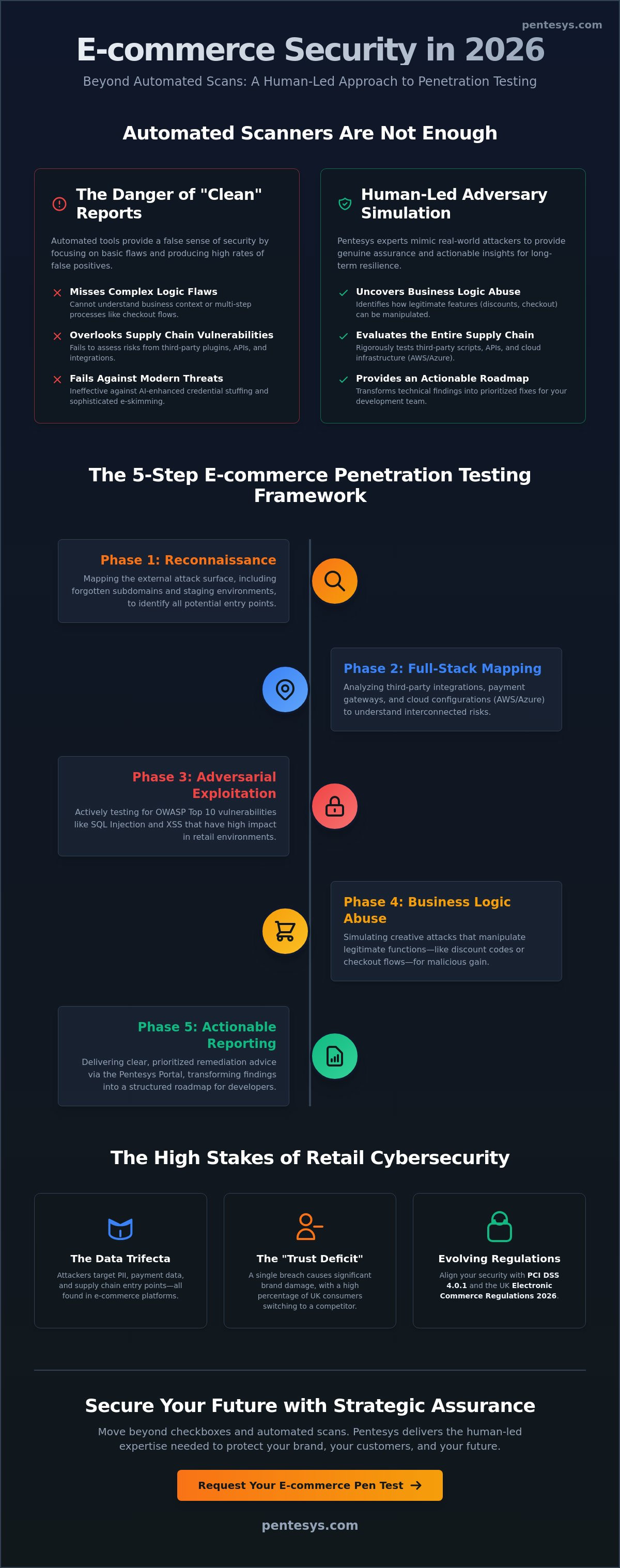
A structured approach to e-commerce website penetration testing ensures that no stone is left unturned in your digital ecosystem. We mirror the journey of a sophisticated threat actor to uncover vulnerabilities across your entire stack. Proper scoping is essential; we include every critical asset from primary storefronts to forgotten staging environments. By integrating these assessments into your modern DevOps and CI/CD pipelines, we help you maintain security without slowing down your release cycles. Business Logic Testing refers to the evaluation of non-technical flaws within functional workflows, such as checkout processes or discount code applications, where legitimate features are manipulated for malicious gain.
Phase 1 & 2: Reconnaissance and Full-Stack Mapping
We begin by mapping your external attack surface to identify every potential entry point. This includes scanning for forgotten subdomains and staging environments that often lack the robust protections of your live site. We also analyse the third-party integrations and API endpoints used for payment processing or stock management. Our experts evaluate the cloud configuration, whether you use AWS or Azure, to ensure your underlying infrastructure doesn’t introduce unnecessary risk. This holistic view is vital because attackers often target secondary systems to pivot into your core database.
Phase 3 & 4: Adversarial Exploitation and Business Logic Abuse
Once we’ve mapped the terrain, we transition to active exploitation. We test for vulnerabilities listed in the industry-standard framework provided by OWASP, focusing on those with the highest retail impact like SQL injection or Cross-Site Scripting (XSS). We go deeper than automated tools by simulating attacks on specific checkout flows. This includes attempting price manipulation, coupon code abuse, and inventory locking. We also assess API security for flaws like Insecure Direct Object Reference (IDOR), where a user might attempt to access another customer’s order history by simply changing a digit in a URL.
Phase 5: Strategic Reporting and Remediation Guidance
The final phase moves away from simple vulnerability lists toward actionable business insights. We provide technical remediation advice specifically tailored for your engineering teams. Through the Pentesys Portal, you can track the status of every finding and manage your remediation workflow in real-time. This ensures that security isn’t just a point-in-time event but a continuous process of improvement. This methodical approach provides the high-level assurance required to protect your brand and maintain customer trust.
Human-Led Expertise vs. Automated Vulnerability Scanning
The most common question we encounter is why a business can’t simply rely on automated scanners to secure their storefront. While automated tools are useful for identifying known signatures and low-hanging fruit, they lack the cognitive ability to understand context or intent. In the 2026 threat landscape, e-commerce website penetration testing must account for attackers who don’t follow a predictable script. Automated tools frequently produce “false positives” that waste your developers’ time, or worse, they miss critical “false negatives” where a vulnerability exists but doesn’t match a pre-defined pattern. Pentesys operates as a human-led authority, using advanced tools only to augment the deep analysis of our security consultants.
Sophisticated threats like e-skimming and supply chain attacks often hide within legitimate scripts. A scanner might see a third-party marketing tag as “safe” because it doesn’t contain a known virus signature. A human expert, however, can identify if that script has been tampered with to exfiltrate payment data to an unauthorised domain. This level of scrutiny is what separates a basic compliance check from genuine adversarial simulation. By prioritising human intuition, we identify the complex multi-step exploitation chains that automated systems routinely overlook.
The Failure of Automation in Business Logic
A scanner is fundamentally unable to understand business context. For example, it cannot determine if a user manipulating a request to change a product price from £1,000 to £0.01 is a technical error or a catastrophic “vulnerability.” It simply sees a successful transaction. Human-led testing identifies these non-technical flaws in checkout or discount workflows by thinking like a malicious actor. To bridge the gap between periodic assessments and real-time threats, many organisations are moving toward continuous penetration testing, which provides ongoing validation of your security posture as your platform evolves.
Professional Assurance vs. Point-in-Time Scans
Professional Assurance is an ongoing state of security validation rather than a one-off event. While a point-in-time scan provides a snapshot of your vulnerabilities today, it offers no protection against the changes you make tomorrow. Having a dedicated security partner who understands your specific retail environment provides the peace of mind that a software dashboard cannot replicate. For a deeper look at why these manual assessments are critical, you can refer to this comprehensive guide to e-commerce penetration testing. We focus on providing actionable insights that allow your engineering teams to build long-term resilience, ensuring your customer data remains protected through every update and integration.
Compliance and Regulatory Requirements for UK E-commerce
Maintaining compliance in the UK retail sector requires more than a superficial scan of your external perimeter. Regulatory bodies and payment processors now demand rigorous, documented evidence that your security controls are effective against modern adversaries. For many businesses, e-commerce website penetration testing serves as the primary mechanism for meeting these obligations. Authenticated testing requires security consultants to access the application using valid credentials to evaluate the security of internal user roles and data isolation. This deep-level access is critical for identifying flaws that remain hidden from unauthenticated external observers.
CREST accreditation is the benchmark for technical competence in the UK. By choosing a partner with these credentials, you demonstrate a commitment to high-level assurance that resonates with both regulators and executive stakeholders. This is particularly relevant when addressing the Electronic Commerce Regulations 2026, which came into force on May 7, 2026. These regulations, alongside ISO 27001 and GDPR, mandate that organisations regularly test and evaluate their security measures to protect consumer data. Our methodology ensures that your technical and organisational measures are not just present, but resilient under pressure.
PCI DSS 4.0: The New Standard for Payment Security
PCI DSS v4.0.1 is the active version of the standard, and as of March 31, 2025, all new requirements are mandatory. This update shifts the focus toward continuous monitoring and a “Customized Approach” for meeting security objectives. We help retailers meet Requirement 11, which dictates the regular testing of systems and processes. This ensures that payment data remains secure throughout the entire transaction lifecycle. For a more detailed look at how these standards impact your strategy, read our guide on CREST accredited penetration testing UK.
Cyber Insurance and Vendor Assessments
UK cyber insurance providers are increasingly requiring proof of professional penetration testing before issuing or renewing policies. A comprehensive assessment can lead to lower premiums by demonstrating a proactive approach to risk management. Beyond insurance, high-value partners and payment gateways often require “Assurance Reports” to verify your security posture. These reports build B2B trust, showing that your infrastructure can handle sensitive transactions without compromising the broader supply chain. Consult with our accredited team to ensure your next assessment meets all UK regulatory requirements and provides the peace of mind your partners expect.
Securing Your Future: Strategic Security with Pentesys
Building a secure digital storefront requires more than a one-off technical check. It demands a transition from reactive vulnerability patching to a state of proactive security resilience. By conducting regular e-commerce website penetration testing, you move beyond basic compliance to establish a robust defence that evolves alongside your business. We believe that cybersecurity is about trust, and our mission is to provide the technical assurance you need to maintain that trust with your customers, partners, and stakeholders. Our approach focuses on long-term stability rather than temporary fixes.
The Pentesys Portal serves as the central, proprietary hub for your entire security journey. It’s not just a repository for reports; it’s a sophisticated platform where you can manage findings, track remediation progress, and access high-level technical guidance in real-time. This technology ensures that our findings are inseparable from your daily operations, making security a managed and dependable process. Instead of wading through static PDF files, your team gains a dynamic view of your security posture, allowing for faster response times and clearer communication between developers and executives.
The Pentesys Advantage: Expert-Led Assurance
We pride ourselves on using CREST-qualified testers who apply advanced adversarial techniques to simulate sophisticated real-world attacks. Our specialists don’t just provide technical data dumps. We deliver actionable insights that translate complex vulnerabilities into clear, prioritised tasks for your engineering teams. This partnership-driven approach ensures that you aren’t just identifying risks, but actively closing the gaps that matter most. We focus on the quality of human intelligence, ensuring that every logic flaw and business risk is identified and addressed with precision.
Getting Started: Scoping Your Assessment
Every retail environment is unique, which is why we work closely with you to define the right testing parameters for your specific architecture. During the initial scoping phase, we identify your most critical assets, including payment gateways, API integrations, and cloud infrastructure. Our engagement process is highly structured, moving from an initial kick-off meeting through active testing and concluding with a detailed final debrief. This transparency ensures you understand every stage of the methodology and the strategic value it provides. Schedule your e-commerce security consultation today to begin building a more resilient future for your online store.
Strengthening Your Storefront for 2026 and Beyond
Securing your digital storefront in the current landscape requires a shift from basic vulnerability scans to a model of continuous assurance. We’ve explored how human-led adversarial simulation identifies the complex logic flaws that automated tools routinely miss. By aligning your strategy with PCI DSS 4.0.1 and the Electronic Commerce Regulations 2026, you ensure that your customer data remains protected and your brand reputation remains intact. This proactive approach transforms security from a technical hurdle into a significant business enabler that supports your growth.
Pentesys provides the technical authority needed to navigate these evolving challenges. Our CREST Accredited Testers deliver more than just a list of flaws; they provide detailed remediation guidance via the Pentesys Portal to help your engineering teams build lasting resilience. Comprehensive e-commerce website penetration testing is the cornerstone of a trust-based relationship with your global customer base. It’s time to move beyond the limitations of automation and embrace a partnership-driven security strategy that prioritises human intuition and expert analysis.
Secure your e-commerce platform with a Pentesys expert assessment today. We’re ready to help you achieve a higher standard of security and long-term peace of mind.
How often should an e-commerce website undergo penetration testing?
You should conduct a full assessment at least once every 12 months or after any significant change to your application or infrastructure. PCI DSS v4.0.1 mandates annual testing to maintain compliance. Many high-growth UK retailers choose quarterly assessments to ensure that new features or third-party integrations don’t introduce logic flaws that automated tools might miss.
Does penetration testing cause downtime for my online store?
Professional testing is specifically designed to avoid service disruption. We coordinate with your technical team to establish safe testing windows and apply rate-limiting to our assessment tools. This methodical approach ensures that your checkout flows and API endpoints remain fully operational for customers while our consultants evaluate their resilience against adversarial techniques.
What is the difference between a vulnerability scan and a penetration test for e-commerce?
A vulnerability scan is an automated process that identifies known security signatures, while e-commerce website penetration testing is a human-led simulation of a real-world attack. Scanners often miss complex logic errors, such as price manipulation or inventory locking. Human expertise is required to chain multiple minor flaws into a successful exploitation path that reflects actual threat actor behaviour.
Is penetration testing required for PCI DSS compliance?
Yes, penetration testing is a mandatory requirement under PCI DSS v4.0.1. Requirement 11 explicitly dictates that organisations must perform internal and external testing at least annually. It also requires a re-test after any “significant change” to ensure that updates to your payment processing environment haven’t introduced new vulnerabilities that could compromise cardholder data.
Can penetration testing detect e-skimming (Magecart) attacks?
Human-led testing is highly effective at identifying the unauthorised script injections used in e-skimming attacks. While automated scanners might view a third-party marketing tag as legitimate, our consultants manually inspect how external dependencies interact with your checkout page. This identifies if sensitive data is being exfiltrated to malicious domains, protecting your customers from sophisticated supply chain compromises.
How much does an e-commerce penetration test cost in the UK?
For small web applications, costs typically range from £4,000 to £12,000 per engagement. Mid-size platforms with multiple integrations generally range between £12,000 and £32,000, while complex enterprise environments can exceed £32,000. These rates reflect the time required for skilled consultants to perform manual validation and provide the high-level assurance that automated shortcuts cannot deliver.
What happens if the penetration test finds critical vulnerabilities?
We provide immediate notification for any critical findings discovered during the assessment. All vulnerabilities are documented within the Pentesys Portal, where your team can access actionable remediation guidance. This allows your developers to begin fixing the most dangerous flaws immediately, ensuring that your security posture is strengthened well before the final debriefing session occurs.
Should I test my staging environment or my live production site?
Testing both environments provides the most comprehensive security view. Staging allows you to identify and remediate flaws before they reach your customers, while production testing is essential to evaluate the actual attack surface. Production assessments account for live cloud configurations and third-party scripts that may not be fully replicated in a development or staging environment.