

Overview
41% of UK health and care organizations reported a cyber breach in 2025, a statistic that proves meeting basic regulatory standards is no longer enough to ensure patient safety. You likely feel the pressure of the June 30, 2026, deadline for DSPT Version 8 while trying to interpret the new Data (Use and Access) Act 2025 reforms. Conducting a rigorous healthcare data security assessment uk is now your primary defense against the $10.93 million average cost associated with healthcare data breaches.
We recognize that balancing rapid digital innovation with strict NHS requirements feels like a moving target. This guide provides a strategic roadmap to help you master the complexities of technical assurance and the mandatory independent audits now required for Category 1 and 2 organizations. We’ll examine how to transition from point-in-time testing to a model of continuous resilience, ensuring your infrastructure remains secure against both state-sponsored threats and identity-based attacks.
Navigating the UK Healthcare Data Security Landscape in 2026
A healthcare data security assessment uk is a comprehensive evaluation of the technical and administrative controls designed to protect patient information. In 2026, this process has evolved from a simple compliance exercise into a critical pillar of clinical safety. It’s no longer sufficient to claim security; organizations must demonstrate it through rigorous evidence and technical assurance. This shift is driven by the increasing sophistication of threats, where 22.5% of all global data breaches in early 2025 targeted the healthcare sector. Effective assessments bridge the gap between high-level policy and the practical reality of defending complex clinical networks.
Handling “special category data” under the Data Protection Act 2018 and UK GDPR requires a strategic approach to risk management. This data, which includes health records and genetic information, carries the highest level of sensitivity. The 2026 regulatory environment has introduced mandatory independent validation for high-risk data processors, moving away from the historical reliance on self-declaration. This change ensures that organizations don’t just meet a baseline, but actually maintain the resilience needed to protect the 9.6 million individuals affected by large-scale breaches in early 2026.
The Role of the Data Security and Protection Toolkit (DSPT)
The DSPT remains the non-negotiable foundation for any organization seeking access to NHS patient data and systems. It’s structured around the 10 Data Security Standards defined by the National Data Guardian, which cover leadership, training, and technical defenses. While self-assessment is the starting point, the 2025-2026 cycle for Version 8 emphasizes audited evidence. There’s a clear distinction between a “tick-box” submission and a technically validated one. We provide the human-led testing required to turn a standard submission into a robust statement of technical assurance, ensuring your organization meets the June 30, 2026, deadline with confidence.
Beyond GDPR: Specific Healthcare Regulations
Compliance in the UK health sector extends into specialized frameworks that go beyond general data protection rules. The UK Medical Device Regulations (UK MDR 2002) now impose strict security requirements on Software as a Medical Device (SaMD), ensuring that code vulnerabilities don’t translate into clinical risks. Furthermore, the Digital Technology Assessment Criteria (DTAC) serves as the benchmark for health tech procurement, focusing on clinical safety and data confidentiality. Every assessment must also incorporate the Caldicott Principles. These principles ensure that every instance of data access is necessary, proportionate, and governed by a culture of trust and transparency.
The Components of a Robust Healthcare Data Security Assessment
A modern healthcare data security assessment uk must account for the diverse technical layers within a Trust or private healthcare provider. It is no longer enough to test the perimeter. You must validate the security of internal clinical networks, public-facing patient portals, and the cloud-hosted databases that store sensitive records. This modular approach ensures that a failure in one area, such as a misconfigured IoT device, doesn’t lead to a total compromise of the patient record system. We focus on identifying these interconnected risks to provide a clear picture of your actual defensive posture.
The assessment process includes infrastructure penetration testing to secure the backbone of clinical networks, alongside web application testing for patient portals. As more organizations migrate to AWS, Azure, or GCP, cloud security assessments become vital for evaluating configurations against NHS data offshoring standards. We also address the growing attack surface of mobile apps and wearable medical devices. These remote monitoring tools often lack the rigorous security controls found in centralized systems, making them attractive targets for adversary simulation.
Securing Patient Portals and Web Applications
Patient portals serve as the primary interface for data access, making them high-value targets. We frequently identify critical vulnerabilities like Insecure Direct Object References (IDOR) and broken access control that automated tools miss. These flaws could allow an unauthorized user to view the medical history of another patient simply by modifying a URL parameter. Testing must also extend to the API endpoints that facilitate data exchange between providers. Human-led testing is essential here; our experts simulate complex clinical workflows to uncover logic flaws that could lead to unauthorized data exfiltration. If you need to validate your external defenses, our team provides tailored web application penetration testing to ensure your portals remain resilient.
Cloud and Infrastructure Resilience
Transitioning to the cloud offers scalability, but it also introduces the risk of misconfigured storage buckets or overly permissive IAM roles. These errors are a leading cause of data exposure. A thorough assessment evaluates these configurations against the standards set by the Data Security and Protection Toolkit. We use infrastructure penetration testing to identify lateral movement risks. This is particularly vital when securing legacy clinical systems that weren’t designed for modern internet connectivity. Attackers often exploit these older systems as an entry point to move toward secure cloud environments. By identifying these paths early, we provide the remediation guidance necessary to harden your infrastructure and maintain long-term assurance.
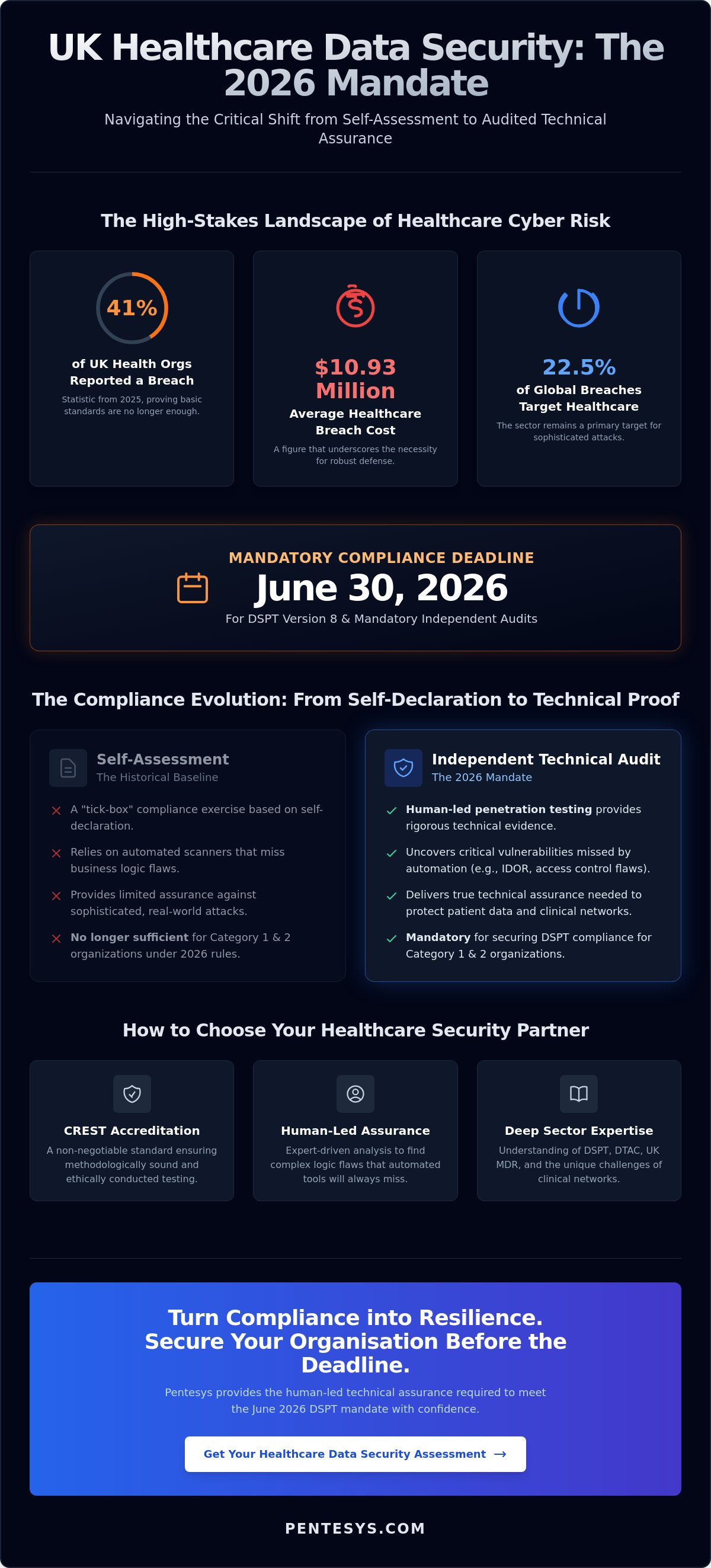
DSPT Self-Assessment vs. Independent Technical Validation
Passing the DSPT is a contractual requirement, but it isn’t a guarantee of technical resilience. While the toolkit provides a necessary administrative framework, it often functions as a “tick-box” exercise that documents the existence of policies rather than their actual effectiveness. A healthcare data security assessment uk must bridge this gap by adopting a “prove it” mentality. Relying solely on self-assessment creates a dangerous disconnect between perceived security and operational reality. Technical validation through penetration testing provides the definitive evidence of effectiveness required to satisfy both internal stakeholders and external regulators.
Boards often ask why they need independent testing after passing the DSPT. The answer lies in the distinction between compliance and security. Compliance is the baseline; technical assurance is the validation of that baseline in the face of an active adversary. Automated vulnerability scans often contribute to a sense of false confidence by flagging known software flaws while missing the complex logic errors and lateral movement paths that human experts identify. Expert-led assessments provide the granular insights needed to protect the 22.5% of healthcare organizations targeted by breaches in 2025.
Why Self-Assessment is No Longer Sufficient
The rise in sophisticated ransomware targeting UK providers has made administrative audits insufficient. These attacks frequently exploit identity misuse and compromised credentials, which are the root cause of most breaches. Adversarial simulations reveal the technical blind spots that a paperwork check will never surface. For instance, testing the “Human Element” through social engineering is critical in clinical settings where staff are under high pressure. We simulate these real-world scenarios to ensure your team can recognize and respond to phishing attempts before they escalate into full-scale data corruption events.
The Value of Independent Technical Assurance
Assurance represents the measurable confidence that your security controls will perform as expected when under attack. This is a central theme in the NCSC Board Toolkit, which encourages leaders to seek objective evidence of their organization’s cyber health. Utilizing CREST accredited penetration testing provides the external credibility needed for successful NHS contract procurement. This level of technical scrutiny is the hallmark of a high-quality healthcare data security assessment uk. Beyond the initial test, we deliver a detailed remediation roadmap through the Pentesys Portal. This structured approach allows your technical teams to move from being merely “compliant” to truly secure, focusing on actionable insights rather than temporary fixes.
How to Choose a Healthcare Security Assessment Provider
Selecting a partner for a healthcare data security assessment uk requires moving beyond basic procurement toward a model of strategic alignment. Clinical environments present unique technical hurdles that a generic testing approach will likely overlook. You need a provider that understands the operational pressures of a Trust while maintaining the technical authority to navigate evolving regulations. Pentesys Limited acts as this sophisticated ally; we provide the expertise required to build long-term resilience rather than just meeting immediate audit requirements.
A high-quality provider must offer a methodology that integrates human intuition with advanced technical execution. This ensures the assessment covers the entire ecosystem, including the identity-based attack vectors that are becoming increasingly prevalent. Your choice should depend on a provider’s ability to deliver actionable insights that bridge the gap between deep-tech execution and business value. This moves the conversation from simple vulnerability counts to strategic risk management.
Critical Accreditation and Expert Markers
CREST accreditation is the non-negotiable benchmark for any UK provider. It guarantees that the individuals performing your assessment adhere to strict ethical codes and have passed rigorous technical examinations. For organizations handling sensitive patient records, SC-cleared testers provide an additional layer of assurance. We prioritize human-led testing because automated tools cannot replicate the creative problem-solving of a skilled adversary. If you’re ready to move beyond automated checklists, you can book a professional security assessment with Pentesys Limited to validate your defenses.
Remediation and Strategic Partnership
Static PDF reports often fail to provide the clarity needed for modern healthcare security teams. A robust healthcare data security assessment uk should deliver findings through a centralized, real-time hub like the Pentesys Limited Portal. This proprietary platform allows your technical and executive teams to track remediation progress as it happens. A true strategic partner offers continuous monitoring to protect your digital estate as it expands. This ensures that new cloud configurations or medical devices don’t introduce unmanaged risks into your clinical workflow.
Pentesys Limited: Human-Led Assurance for UK Health and Care
Pentesys Limited serves as a strategic ally for organizations requiring a healthcare data security assessment uk. We don’t view security as a series of isolated hurdles; it’s a managed, ongoing process that builds enterprise-grade resilience. Central to this approach is the Pentesys Limited Portal. This proprietary hub acts as the single source of truth for your security posture, allowing technical teams and executives to track remediation guidance in real time. By centralizing all vulnerability management data, we provide the absolute clarity needed to make informed, risk-based decisions that protect both patients and reputation.
Our philosophy centers on the belief that cybersecurity is about trust. This trust is earned through human-led assurance rather than the shortcuts of fully automated scans. While automation has its place for basic checks, it lacks the intuition required to navigate complex clinical environments. Our testers perform adversary simulations that replicate the exact tactics used by modern threat actors. This methodical approach ensures we uncover the logic flaws and configuration errors that could lead to the corruption of patient records or unauthorized data access, maintaining the integrity of the clinical data lifecycle.
The Pentesys Limited Approach to Healthcare Security
We’ve designed our methodology to ensure that technical testing never disrupts critical patient care services. We coordinate closely with your clinical and IT teams during the planning stages to establish clear rules of engagement. This ensures that infrastructure penetration testing and web application assessments occur without impacting live medical systems. Pentesys Limited provides the technical validation required for DSPT Version 8 compliance, turning a mandatory submission into a robust statement of assurance. Our reports offer actionable insights and enterprise-grade remediation advice, ensuring your team knows exactly how to harden your defenses before the June 2026 deadline.
Continuous Monitoring for the Digital Health Estate
The transition from point-in-time testing to continuous security validation is essential for modern HealthTech firms. As your digital estate grows, so does your attack surface. Pentesys Limited provides continuous external attack surface monitoring to identify new risks as they emerge, bridging the gap between deep-tech execution and executive business value. This proactive stance moves your organization beyond reactive fixes toward long-term resilience. It’s a structured rhythm of security that mirrors the continuous nature of the healthcare services you provide. Secure your healthcare data with Pentesys Limited expert-led assessments.
Securing the Future of Patient Trust and Data Integrity
The 2026 regulatory landscape requires a transition from static compliance to a model of continuous technical assurance. Meeting the June 30, 2026, deadline serves as the baseline requirement; however, true resilience comes from identifying the lateral movement risks and logic flaws that automated tools consistently miss. By prioritizing human-led testing, you protect your organization from the identity-based attacks that have become a primary vector for data corruption. It’s about moving beyond the checklist to achieve genuine operational security through a comprehensive healthcare data security assessment uk.
A strategic approach provides the evidence of effectiveness needed to satisfy stakeholders and secure NHS contracts. Pentesys Limited delivers this through our CREST-accredited technical expertise and our proprietary portal, which serves as your central hub for real-time remediation. This approach ensures your security posture remains robust as your digital estate evolves. We’re here to act as your sophisticated ally in this process. You can Book Your CREST-Accredited Healthcare Security Assessment today to establish a foundation of trust for your patients. Your journey toward a more resilient clinical environment starts with a single, methodical step.
What is a healthcare data security assessment in the UK?
It’s a structured evaluation of an organization’s ability to protect patient data against technical and administrative risks. This process involves testing the resilience of clinical networks, applications, and cloud environments against real-world attack vectors. The assessment provides a clear roadmap for technical remediation, ensuring that your infrastructure meets the rigorous requirements of the UK health sector.
Is a penetration test mandatory for NHS DSPT compliance?
Yes, independent technical validation is now a mandatory requirement for Category 1 and 2 organizations under the 2025/2026 DSPT cycle. While smaller entities may rely on self-assessment, high-risk processors must provide evidence of effectiveness through professional testing. This validation is essential for maintaining access to NHS systems and demonstrating a commitment to protecting special category data.
How often should a healthcare provider conduct a security assessment?
You should conduct a comprehensive assessment at least once every 12 months to meet annual DSPT standards. However, the 2026 threat landscape favors a continuous monitoring approach rather than point-in-time testing. Assessments are also necessary after significant infrastructure changes, such as migrating legacy records to a new cloud environment or deploying new patient-facing applications.
What is the difference between a vulnerability scan and a penetration test in healthcare?
A vulnerability scan is an automated tool that identifies known software flaws, whereas a penetration test is a human-led simulation of an active attack. In a healthcare data security assessment uk, penetration testing is superior because it uncovers complex logic errors and lateral movement paths that automated scanners consistently miss. Human intuition is required to understand how attackers exploit clinical workflows.
How does the DTAC impact security assessments for health apps?
The Digital Technology Assessment Criteria (DTAC) sets the benchmark for clinical safety and data confidentiality for health technologies. It requires evidence of rigorous security testing, specifically focusing on API and mobile application assessments. Meeting DTAC standards is essential for any developer seeking to have their technology adopted by NHS Trusts or social care providers in 2026.
What happens if a healthcare data security assessment reveals critical vulnerabilities?
Identifying critical flaws allows you to implement technical remediation before an actual breach occurs. We provide detailed guidance through the Pentesys Portal to help your teams prioritize fixes based on their potential impact on patient safety. Resolving these issues promptly demonstrates a proactive approach to security and helps maintain your organization’s status as a trusted data processor.
Can a security assessment be performed on live clinical systems without downtime?
Yes, professional testers perform assessments on live systems by using non-disruptive methodologies. We coordinate with your technical teams to establish clear rules of engagement before testing begins. This ensures that infrastructure and application testing occur safely without impacting critical patient care or clinical workflows, allowing you to maintain operational continuity throughout the process.
What qualifications should a healthcare security auditor have?
Auditors should hold CREST certifications to ensure they meet the highest technical and ethical standards for penetration testing in the UK. For assessments involving sensitive patient data or central NHS systems, it’s also advisable to use testers with SC clearance. These qualifications guarantee that the individual has the specialized knowledge required to navigate the unique complexities of healthcare infrastructure safely.