

Overview
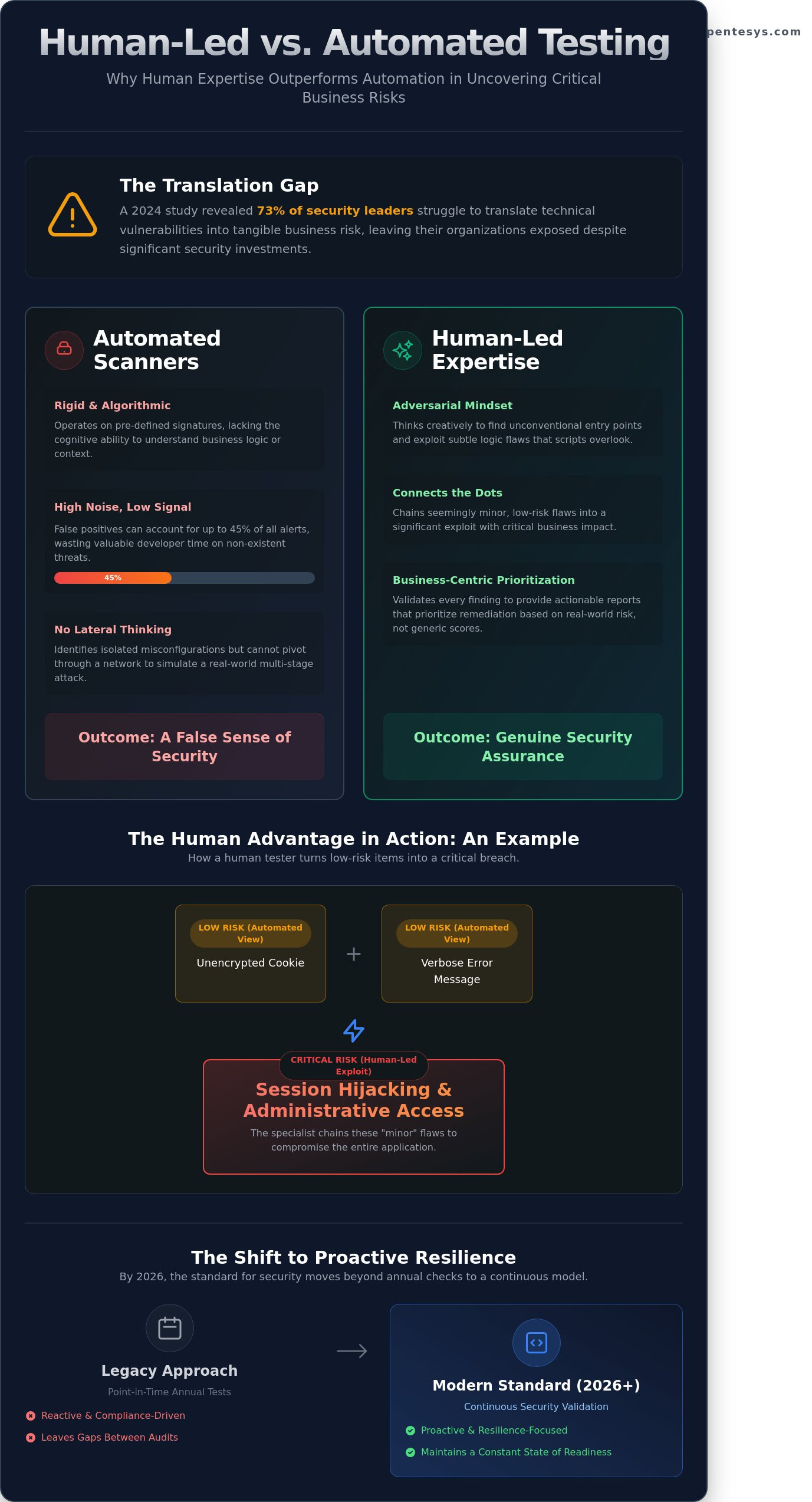
By 2026, an automated scan disguised as a manual assessment is no longer just a budget waste; it’s a critical business liability. You likely recognise the frustration of investing in penetration testing only to receive a technical report that your board cannot interpret or that fails to meet stringent ISO 27001 requirements. A 2024 industry study revealed that 73% of security leaders struggle to translate technical vulnerabilities into business risk, which leaves organisations exposed despite their annual spend. It’s time to move away from the reactive cycle of point-in-time checks.
This guide provides the strategic framework you need to master the complexities of modern testing, helping you move beyond basic compliance to achieve genuine technical resilience. We’ll explore how human-led expertise and the Pentesys Portal offer a clear roadmap for remediation. This approach provides the proactive assurance your stakeholders and cyber insurance providers demand for the year ahead.
What is Penetration Testing? Beyond the Compliance Checklist
A penetration test is an authorised, simulated attack on your organisation’s digital infrastructure to identify and exploit vulnerabilities. While many UK businesses treat this as a box-ticking exercise for GDPR or ISO 27001 compliance, true security assurance goes much deeper. Unlike a basic vulnerability assessment, which uses automated tools to list potential weaknesses, penetration testing involves manual exploitation by skilled specialists. This process determines if a vulnerability is actually exploitable and what level of damage an adversary could realistically inflict.
The National Cyber Security Centre (NCSC) compares this process to a financial audit. Just as an auditor verifies that a company’s financial statements accurately reflect its health, a penetration tester verifies that your security controls actually work in practice. By 2026, relying on static defences is no longer a viable risk management strategy for British enterprises. Organisations must treat security as a dynamic, verified process to maintain resilience against increasingly sophisticated threats.
The Core Purpose of Security Assurance
The primary goal is to move from a state of hoping your systems are secure to knowing exactly how they could be breached. Automated tools often miss subtle logic flaws or complex attack chains that only a human expert can identify. We focus on providing this level of human-led assurance. We validate that your security personnel and technical controls perform as expected under pressure, identifying gaps that software alone cannot detect. This approach ensures that remediation guidance is prioritised based on actual business risk rather than generic severity scores. In a similar vein of professional verification, those interested in how human credibility is assessed can visit Morgan Polygraph to discover how experts debunk common myths about lie detector tests.
The Evolution of the Threat Landscape
Adversary behaviour has shifted significantly with the rise of AI-driven attacks. Data from 2024 showed that 50% of UK businesses experienced a cyber attack in the previous 12 months, and the speed of exploitation has only increased. In the fast-moving cloud environments of 2026, an annual test is rarely enough to ensure safety. Security is now a continuous requirement. There is a clear industry shift toward “Continuous Security” as the new standard. This ensures that new deployments or configuration changes don’t introduce critical risks between scheduled audits, providing a constant state of readiness.
Human-Led vs Automated Testing: Why Expertise Still Wins
Many UK organisations mistake automated vulnerability scans for a comprehensive penetration test. While automation provides a useful baseline for identifying known software patches, it lacks the cognitive depth required to uncover sophisticated security gaps. Pentesys views automation as a supportive tool rather than a replacement for professional intuition. Relying solely on software often creates a false sense of security while leaving complex logic flaws untouched.
The Pitfalls of Automated Vulnerability Scanners
Scanners operate on pre-defined signatures and rigid algorithms. They don’t understand your specific business logic or the nuances of your industry’s operational requirements. A 2023 study by the Ponemon Institute indicated that false positives can account for up to 45% of all security alerts. This creates a significant drain on internal resources, as developers must spend time investigating non-existent threats instead of fixing genuine risks. Automated tools also fail to simulate lateral movement. They might identify a weak service configuration but won’t attempt to use that foothold to pivot through your network to access sensitive financial data or intellectual property.
The Value of the Specialist Mindset
True security assurance comes from the ability to chain seemingly minor flaws into a significant exploit. An automated tool might flag an unencrypted cookie and a verbose error message as two separate, low-risk issues. A human tester sees a path to hijack a session and gain administrative access. Our specialists think like adversaries to find unconventional entry points that a script would naturally overlook. We prioritise this manual verification for every finding to ensure your report is accurate and actionable.
Human-led testing is the gold standard for high-stakes environments because it provides the nuanced analysis that automated shortcuts cannot replicate. We use tools to handle the repetitive discovery phases, but we reserve our experts for the heavy lifting of exploitation and strategic analysis. This methodology ensures that your penetration testing results are rooted in real-world risk rather than theoretical checklists.
Our approach integrates the Pentesys Portal to deliver these insights clearly. This ensures that manual findings are translated into precise remediation guidance that your technical team can implement immediately. If you want to move beyond basic scans, you can explore our specialist-led approach to secure your infrastructure. By choosing a partner that values human intelligence over shortcut automation, you build long-term resilience against an evolving threat landscape.
The Core Domains: Web, Infrastructure, and Cloud Security
Securing a modern UK business requires a multi-layered strategy that moves beyond simple perimeter defence. A diverse digital estate demands a modular approach to security, as the vulnerabilities found in a public-facing website differ fundamentally from those hidden within a corporate network or a cloud-hosted environment. Professional penetration testing provides the technical assurance that these disparate components work together securely, rather than creating silos of risk. By categorising the digital estate into specific domains, organisations can apply the precise level of human intelligence needed to identify complex logic flaws that automated scanners consistently overlook.
Web Application and API Penetration Testing
Web applications often serve as the primary gateway for sensitive customer data. Our human-led assessments focus on the OWASP Top 10, identifying critical flaws like Broken Access Control and Injection. APIs represent the new frontier for data breaches in the UK, with the 2023 Verizon Data Breach Investigations Report highlighting that web application attacks are involved in 26% of all breaches. We test both authenticated and unauthenticated states to ensure that logic flaws in SaaS platforms do not permit unauthorised data extraction. This rigorous process ensures that your bespoke software remains a business asset rather than a liability.
Infrastructure and Network Assessments
Network security requires a dual perspective to be effective. External testing simulates an attacker attempting to breach the perimeter, while internal testing addresses the “insider threat” or the potential for lateral movement following a successful initial compromise. Many UK enterprises still operate legacy systems that lack modern security patches. We prioritise hardening network configurations and identifying these legacy weaknesses. Our methodology includes detailed audits of firewall configurations and network segmentation, ensuring that a single compromised device cannot lead to a full-scale estate breach.
Cloud Security and Adversarial Simulations
Cloud environments such as AWS, Azure, and GCP introduce complex Identity and Access Management (IAM) challenges. Misconfigurations in these settings are a leading cause of data exposure, often occurring when permissions are overly permissive. While standard penetration testing identifies technical gaps, our advanced Red Teaming goes further by simulating a persistent adversary. This includes testing the human element through sophisticated social engineering and phishing simulations. By mimicking real-world attack patterns, we provide actionable insights that help your team build long-term resilience against evolving threats. All findings are delivered through the Pentesys Portal, providing a central hub for remediation guidance and strategic security management.
The Penetration Testing Lifecycle: From Scoping to Remediation
Professional penetration testing isn’t a random series of attacks. It’s a structured lifecycle designed to provide total assurance. This methodical approach ensures that every engagement is repeatable, safe, and aligned with your specific business objectives. By following a clear progression, we move from initial curiosity to a state of verified resilience. It’s a process that balances technical depth with business continuity.
Planning, Scoping, and Reconnaissance
The success of the engagement depends on the scoping phase. We work with your team to define the rules of engagement, identifying “no-go” zones to prevent any disruption to your live operations. You’ll choose a methodology that fits your current security maturity. Black Box testing simulates an external attacker with zero prior knowledge; Grey Box testing provides our consultants with standard user credentials; White Box testing involves full access to source code and network diagrams. This phase includes deep information gathering to map your target environment, ensuring business-critical assets are prioritised for testing.
Execution: Vulnerability Analysis and Exploitation
Our experts conduct a systematic search for flaws, moving beyond automated checklists to identify complex logic errors. We then move to controlled exploitation. We safely validate vulnerabilities to prove their impact, documenting evidence of a successful breach while maintaining system stability. Exploitation is the key differentiator from a mere scan, as it confirms whether a vulnerability is truly exploitable in your specific environment. This human-led approach ensures we find the critical flaws that automated tools typically miss. Our consultants act as a sophisticated ally, showing you exactly how an adversary would move through your network.
Reporting and the Remediation Roadmap
Data only becomes valuable when it’s actionable. We deliver a comprehensive report that bridges the gap between technical teams and the boardroom. Your executives receive a high-level summary of risk, while your developers get a technical guide for remediation. The Pentesys Portal acts as your central hub, allowing you to track remediation progress in real time. We prioritise fixes based on the actual risk to your organisation, considering that 84% of UK businesses identified cyber security as a high priority in the 2023 Cyber Security Breaches Survey. This ensures your resources are spent where they’ll have the greatest impact on your security posture.
Secure your business-critical assets with a strategic approach to security. Explore our professional penetration testing services
Building Long-Term Resilience with Continuous Security Validation
Effective cyber defence isn’t a point-in-time event; it’s a continuous cycle of assessment and improvement. Many UK organisations treat penetration testing as a checkbox exercise completed once a year to satisfy a specific auditor. This approach fails to account for the speed of modern software development and infrastructure changes. Vulnerabilities can appear the moment a developer pushes new code or a cloud configuration is modified. Continuous External Attack Surface Monitoring (EASM) provides a proactive layer of protection, identifying these risks in real time to ensure your digital estate remains visible between formal assessments.
Compliance and Regulatory Alignment
Maintaining high standards of security is now a prerequisite for doing business in the UK. Regular testing is a core requirement for several critical frameworks and financial protections:
- ISO 27001: Clause A.12.6.1 specifically requires organisations to obtain information about technical vulnerabilities and take appropriate measures.
- SOC2: Trust Services Criteria demand regular monitoring and testing of the controls that protect your data environments.
- UK Cyber Insurance: Carriers now demand proof of consistent security validation. The UK Government’s 2023 Cyber Security Breaches Survey found that 32% of businesses identified a breach in the last year; insurers are raising premiums or denying coverage to firms that lack rigorous, CREST-accredited testing regimes.
Continuous Monitoring and Vulnerability Management
Your attack surface changes every time you update a web application or add a new user to your network. Relying on annual audits creates a “security gap” where vulnerabilities can remain undetected for months. Pentesys bridges this gap by moving your organisation from a state of annual panic to a steady state of assurance. We combine automated discovery with sophisticated human-led penetration testing to identify complex logic flaws that scanners often miss.
The Pentesys Portal serves as the central hub for your security programme, providing a transparent view of your current risk posture. It replaces static, outdated PDF reports with a dynamic dashboard that offers clear remediation guidance for your technical teams. By prioritising fixes based on actual risk rather than theoretical severity, your internal resources can focus on the issues that matter most. This methodical approach ensures that security becomes a managed, predictable business process rather than a series of reactive emergencies.
Pentesys acts as your strategic ally, providing the technical authority and human intuition needed to stay ahead of evolving threats. Our focus on long-term resilience gives your leadership team the peace of mind that your defences are being validated by experts who understand the UK’s unique regulatory landscape. By choosing a partnership-driven model, you ensure that your security posture evolves at the same pace as your business. This philosophy is shared by high-quality providers globally; for example, those seeking Managed IT Services Pearland TX can find the same commitment to managed security and infrastructure integrity.
Transforming Security Into a Strategic Asset
By 2026, the gap between automated scanning and genuine security assurance will widen significantly. Industry data indicates that human-led penetration testing identifies critical logic flaws that automated tools miss in 80% of enterprise environments. Moving beyond a simple compliance checklist allows your organisation to build long-term resilience across web, cloud, and physical infrastructure. This strategic shift ensures your security posture evolves alongside the threat landscape rather than lagging behind it.
Pentesys provides the technical authority required to navigate this complexity. Our CREST-accredited experts conduct deep-dive assessments that prioritise human intuition over the shortcuts of fully automated solutions. You can manage the entire security lifecycle through our proprietary Pentesys Portal, which offers real-time remediation tracking to bridge the gap between discovery and resolution. This methodical approach transforms security from a periodic hurdle into a continuous, managed process that protects your business value.
Request a tailored security assurance proposal from Pentesys to secure your digital infrastructure with confidence. We’re ready to partner with you on the path to total resilience.
What is the difference between a vulnerability scan and a penetration test?
A vulnerability scan is an automated process that identifies known security weaknesses, whereas a penetration test is a manual, human-led simulation of a real-world attack. Scans provide a broad overview of potential entry points; however, testers exploit those vulnerabilities to see how far an intruder can penetrate. This manual approach provides a level of assurance that automated software cannot replicate on its own.
How often should my organisation perform penetration testing?
UK organisations should conduct penetration testing at least once every 12 months or immediately following significant infrastructure changes. Regulatory frameworks like PCI DSS 4.0 mandate annual assessments to maintain compliance. For businesses handling sensitive data, a continuous testing model via the Pentesys Portal offers better long-term resilience than a single point-in-time assessment that quickly becomes outdated.
Will a penetration test cause any downtime for my business?
Professional testing rarely causes downtime because it’s carefully scoped and managed to avoid disrupting your live operations. Our testers work within agreed parameters and can perform assessments during out-of-hours windows if your systems are particularly sensitive. We maintain constant communication through our portal to ensure technical stability and operational continuity throughout the entire engagement.
What is the average cost of a penetration test in the UK?
The average daily rate for a CREST-accredited tester in the UK typically ranges from £1,000 to £2,500. A standard 5-day assessment usually costs between £5,000 and £12,500 depending on the complexity of your environment. Total investment depends on the specific scope of the adversary simulation and the number of assets requiring technical validation.
Do we need a penetration test for ISO 27001 certification?
Yes, ISO 27001:2022 requires regular technical vulnerability assessments under Control A.8.8 to ensure your security measures remain effective. While the standard doesn’t explicitly name “penetration testing” as the only method, it’s the industry-recognised way to prove you’ve validated your defences. Auditors expect to see evidence that you’ve tested your controls against realistic threat scenarios.
What is the difference between Black Box and White Box testing?
Black Box testing simulates an external attacker with zero prior knowledge of your systems; White Box testing provides the tester with full architectural diagrams and credentials. White Box assessments are often more thorough because they allow for a deeper dive into the code and internal configurations. This identifies hidden risks that external scans or uninformed attackers might miss during a shorter engagement.
How long does a typical penetration test take to complete?
A standard penetration testing engagement usually takes between 3 and 10 working days to complete from start to finish. The planning phase takes 1 day, followed by 3 to 5 days of active testing, and a final 2 days for reporting and remediation guidance. Larger enterprise-grade environments or complex web applications may require a longer duration to ensure comprehensive coverage.
Why is human-led testing better than automated tools?
Human-led testing identifies logical flaws and complex exploit chains that automated tools consistently overlook. While software can find missing patches, a skilled tester uses intuition to bypass security controls and simulate sophisticated adversary tactics. This manual approach delivers actionable insights and strategic value, helping you build genuine resilience rather than just ticking a compliance box.