

Overview
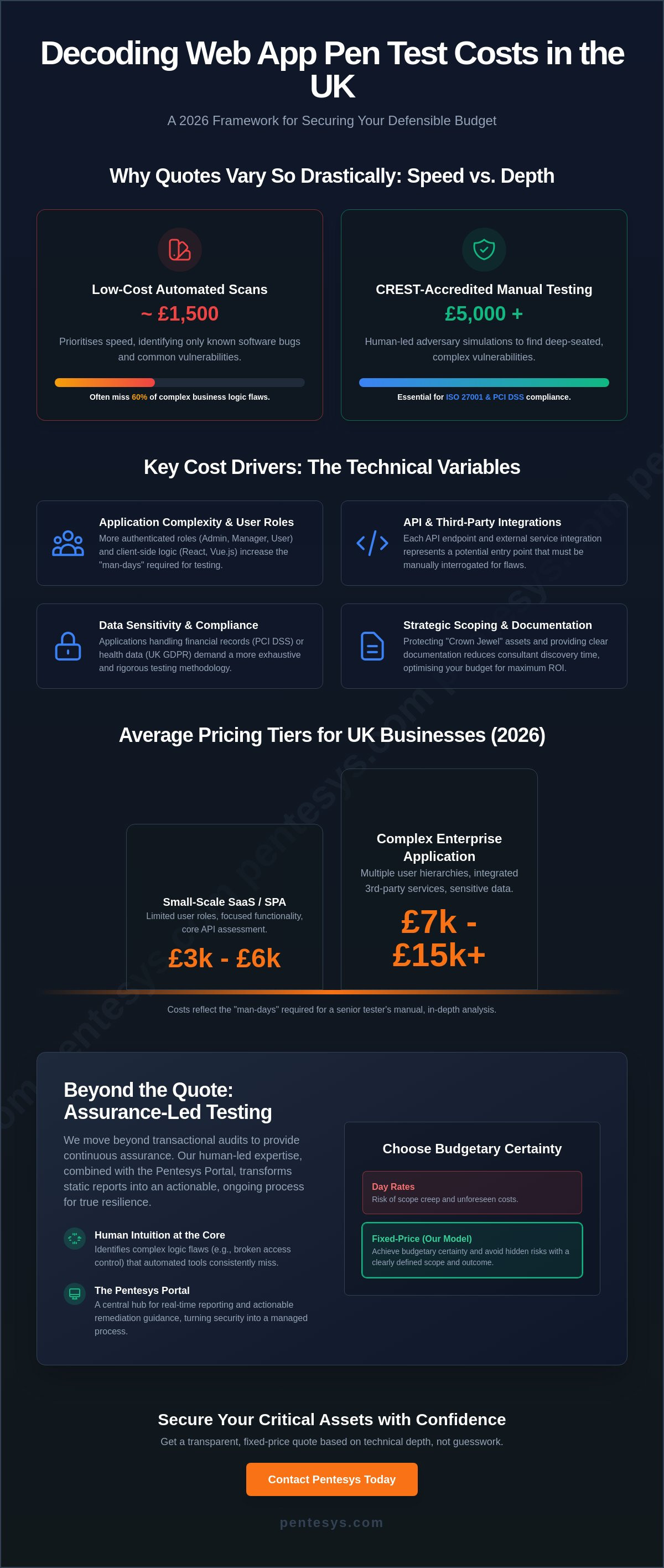
Receiving three quotes for the same project scope that vary by as much as £5,000 is not a sign of a competitive market; it’s a sign of a fragmented industry that often prioritizes automated speed over technical depth. You likely recognize that a £1,500 automated scan cannot provide the same level of assurance as a CREST-accredited professional conducting a manual adversary simulation. Yet, justifying that price gap to a board focused on the bottom line remains a significant hurdle for many UK security leaders who need to maintain ISO 27001 or PCI DSS compliance.
This guide establishes a clear framework for the web application penetration testing cost uk landscape in 2026, helping you secure a defensible budget that satisfies both your CFO and your technical auditors. We move beyond vague estimates to examine the specific variables that drive pricing, from the complexity of your API architecture to the necessity of human intuition in identifying business logic flaws. You’ll learn how to identify genuine value in a crowded market and ensure your investment delivers actionable remediation guidance rather than just a static list of automated alerts.
The Current Landscape of Web Application Penetration Testing Costs in the UK
In 2026, the UK cybersecurity market has shifted toward a model of continuous resilience. For organisations evaluating the web application penetration testing cost uk, the landscape is defined by a move away from commoditised scanning and toward specialist, human-led assessments. CREST-accredited firms now command a premium because they provide the technical depth required to satisfy modern supply chain demands. Relying on “cheap” automated tests often results in a false sense of security, as these tools frequently miss complex logic flaws that lead to 60% of successful breaches in cloud-native applications.
A fundamental starting point for many procurement teams is defining the scope of work. Understanding What is a penetration test? is vital to distinguish between a superficial vulnerability scan and a deep-dive manual assessment. While a scan identifies known software bugs, a true penetration test involves an ethical hacker attempting to bypass security controls. This distinction is critical for meeting UK regulatory requirements. Frameworks such as ISO 27001 and PCI DSS v4.0 now mandate rigorous testing that proves an organisation’s ability to defend against sophisticated adversary simulations.
Average Pricing Tiers for UK Businesses
Pricing is rarely uniform because every application architecture is unique. For a small-scale SaaS or a single-page application (SPA) with limited user roles, businesses typically expect to invest between £3,000 and £6,000. This covers a targeted assessment of the core logic and API endpoints. Complex enterprise applications, which often feature multiple user hierarchies and integrated third-party services, generally range from £7,000 to £15,000 or more. The web application penetration testing cost uk is ultimately a reflection of the “man-days” required for a senior tester to manually probe the environment for vulnerabilities that automated scripts simply cannot see.
The Rise of Assurance-Based Testing
Pentesys views security as a partnership rather than a transactional audit. We focus on “assurance,” a concept that prioritises long-term resilience over point-in-time compliance. This approach relies on human intuition to identify complex logic flaws, such as broken access control or insecure direct object references, which automation often misses. By using the Pentesys Portal as a central hub for remediation guidance and real-time reporting, we ensure that testing leads to actionable insights. Our methodology moves beyond static reports, positioning cybersecurity as a managed, ongoing process that builds genuine trust with your stakeholders.
Technical Variables: What Actually Drives Your Pen Test Quote?
Estimating a web application penetration testing cost uk involves more than a cursory glance at your homepage. Every quote is built on the technical surface area our consultants must interrogate. A simple marketing site requires significantly less effort than a multi-tenant SaaS platform handling Special Category Data under UK GDPR. The depth of testing, ranging from standard OWASP Top 10 checks to sophisticated adversary simulations, dictates the human hours required for a thorough assessment.
Data sensitivity remains a primary driver of rigour. If your application processes financial records or health data, the testing methodology must be more exhaustive to provide the necessary assurance. This level of detail ensures that your security posture stands up to real-world threats, moving beyond simple automated scans to human-led intelligence. This methodical approach provides the peace of mind that your most valuable digital assets are protected against targeted attacks.
Application Complexity and User Roles
The number of authenticated user roles significantly impacts the engagement timeline. Testing as an unauthenticated user is the baseline, but true security requires examining privilege escalation. If your app has four distinct roles, we must test each one to ensure a “Standard User” cannot access “Admin” functions. Modern frameworks like React or Vue.js also add complexity. These libraries move much of the application logic to the client side, requiring our experts to spend more time analysing front-end code for vulnerabilities that traditional scanners often miss.
API and Third-Party Integrations
Modern web apps often function as “headless” entities, relying on complex backends and microservices. Securing these data transfers is critical, as 83% of web traffic now flows through APIs according to recent industry reports. If your API documentation is incomplete, it increases the time spent on discovery and mapping. High-quality Swagger or OpenAPI documentation allows our team to move straight to testing, which can help manage your web application penetration testing cost uk by streamlining the initial phases of the project.
Compliance and Reporting Requirements
Your regulatory environment often dictates the scope of the engagement. For example, firms pursuing UK Cyber Essentials Plus or ISO 27001:2022 certification require specific evidence of technical controls. Following the PCI DSS penetration testing guidance is also essential for any business handling cardholder data. We provide both technical reports for your developers and executive summaries for your board, ensuring every stakeholder receives actionable insights. To see how these variables apply to your specific environment, you can request a tailored assessment proposal through our portal.
Pricing Models Compared: Day Rates vs. Fixed-Price vs. Continuous Security
Understanding how providers calculate the web application penetration testing cost uk businesses face is vital for effective procurement. Most firms choose between time-based billing, fixed-scope projects, or modern subscription-led assurance. Each model impacts your security posture and your bottom line differently.
The Traditional Day Rate Model
In the UK, CREST-certified consultants typically command day rates between £800 and £1,500. This depends on the seniority of the tester and the complexity of the application. While this model offers flexibility, it often introduces the risk of scope creep. If a tester discovers a complex vulnerability chain midway through the project, the timeline expands; so does the final bill. This model suits agile development cycles where testing occurs in short, frequent bursts, but it lacks the predictability required for fixed annual budgets.
Fixed-Price Assurance: Budgetary Peace of Mind
For UK SMEs, fixed-price engagements remove financial ambiguity. Pentesys creates these quotes through a detailed scoping call process, ensuring every endpoint, API, and user role is accounted for before work begins. This provides a definitive web application penetration testing cost uk leaders can approve with confidence. A comprehensive fixed-price project should include:
Including re-testing in the initial fee is essential. Without it, businesses often find themselves paying twice to verify that identified flaws are actually fixed.
- Detailed vulnerability analysis and manual exploitation.
- Actionable remediation guidance tailored to your dev team.
- Complimentary remediation re-testing to verify that flaws are closed.
- A final executive summary for stakeholders.
Continuous vs. Point-in-Time Testing
Annual assessments provide a snapshot of security, yet data suggests many vulnerabilities are introduced between scheduled tests. Relying on a single yearly event is no longer a viable strategy for modern attack surfaces. Transitioning to Continuous Penetration Testing offers a higher ROI by reducing the cost per vulnerability found over a 12-month period. This model shifts security from a reactive hurdle to a proactive business asset.
Pentesys delivers this assurance through the Pentesys Portal. This proprietary hub serves as the central delivery mechanism, allowing our human experts to focus on complex adversary simulation rather than manual reporting. We combine human intuition with technology to ensure that security stays a managed, ongoing process. This methodology provides long-term resilience, moving beyond the shortcuts of purely automated scans to deliver genuine enterprise-grade protection. It’s a strategic approach that prioritizes quality and human intelligence over temporary fixes.
How to Optimise Your Pen Test Budget for Maximum ROI
Investing in security requires a strategic approach to ensure every pound spent delivers tangible protection. To manage the web application penetration testing cost uk effectively, businesses should transition from viewing tests as isolated events to seeing them as part of a managed security lifecycle. Efficiency starts with preparation; the more information a consultant has upfront, the less time they spend on discovery and the more time they spend on actual exploitation and analysis.
Strategic scoping allows you to focus resources on your ‘Crown Jewels’-the specific modules that handle sensitive data or process transactions. Testing every static page of a marketing site is rarely a good use of budget. Instead, direct the effort toward your APIs and authentication logic. Consolidating services also provides significant value. Bundling cloud, infrastructure, and web app testing into a single package reduces administrative overhead and provides a holistic view of your security posture. This integrated methodology ensures that your investment addresses the most critical risks first, providing the assurance needed to operate with confidence.
Preparing Your Application for Testing
Delays during the testing window directly inflate costs. Ensuring your staging environment is ‘test-ready’ before the consultant arrives prevents wasted billable days. This means pre-provisioning accounts, whitelisting IP addresses, and ensuring the application is stable. Having developers available to answer technical queries or reset environments ensures the tester spends 100% of their time hunting for vulnerabilities. A robust ‘Rules of Engagement’ document acts as a safeguard, defining clear boundaries to prevent expensive scope creep. Organizations that prepare thoroughly often see a 15% reduction in the total web application penetration testing cost uk by avoiding project extensions.
The Value of High-Quality Remediation
True cost efficiency is found in the remediation phase. A low-cost provider often delivers a 100-page automated report filled with false positives. This forces your internal team to waste dozens of hours filtering through noise. In contrast, Pentesys provides concise, human-led reports through the Pentesys Portal. These focus on actionable insights rather than automated fluff. By removing false positives, we reduce the time your developers spend on fixes, which can save organizations over £2,000 in internal engineering time per project. Our technical guidance ensures your team fixes the root cause of a bug, preventing it from reappearing in future code releases.
Ready to streamline your security strategy and maximize your budget? Get an expert-led quote for your next pen test.
Beyond the Quote: Why Assurance-Led Testing with Pentesys Delivers Value
Selecting a provider based solely on the initial web application penetration testing cost uk can be a short-sighted strategy. True value emerges from the depth of the assessment and the long-term support provided after the initial report. Pentesys operates on an assurance-led model. This means we don’t just identify vulnerabilities; we partner with you to build a resilient security posture. Our approach moves the needle from a simple compliance checkbox to a strategic security alliance. By integrating human intelligence with our proprietary technology, we ensure your investment translates into measurable risk reduction rather than just a list of flaws.
Leveraging the Pentesys Portal for Efficiency
The Pentesys Portal serves as the central hub for your entire security engagement. It eliminates the traditional delay between testing and remediation. You don’t need to wait for a static PDF to arrive in your inbox to start securing your code. Instead, findings are uploaded to the digital hub in real-time as our consultants discover them. This allows your development team to begin patching critical issues immediately, often before the engagement is even finished. The portal also simplifies the administrative side of security management:
- Streamlined Re-testing: Request follow-up assessments through a single interface once fixes are deployed.
- Historical Benchmarking: Track your security posture over time to demonstrate improvement to stakeholders.
- Actionable Insights: Access clear remediation guidance that speaks the language of your developers.
The Importance of UK-Based CREST Expertise
The quality of your web application penetration testing cost uk is directly tied to the credentials of the people performing the work. Pentesys relies on human-led expertise to uncover complex logic flaws that automated scanners consistently miss. Our consultants are CREST-certified, ensuring they meet the highest standards of technical skill and ethical conduct. This human element is the core of our philosophy. We think like an adversary to find the gaps that software cannot see.
Data residency is equally vital for UK businesses. Because Pentesys is UK-based and operated, your sensitive vulnerability data remains within UK jurisdiction. This simplifies your GDPR compliance and ensures that your most private security information isn’t stored on overseas servers with different legal protections. It’s about more than just a test; it’s about trust and legal certainty. We provide a fixed-price assurance model that gives you total budget clarity without hidden fees or surprise costs. Contact our team today to request a bespoke quote and start your journey toward a more resilient digital future.
Securing Your Digital Assets for 2026 and Beyond
Navigating the web application penetration testing cost uk landscape requires a move away from simple price-per-day metrics. By 2026, UK organisations must prioritise strategic assurance over tick-box compliance to meet evolving regulatory standards like DORA or Cyber Essentials Plus. Effective procurement focuses on clear technical scoping, including the number of dynamic pages and API integrations, which ensures your budget targets genuine risk rather than surface-level vulnerabilities.
Pentesys provides this clarity through human-led testing delivered by CREST-accredited technical experts. We replace static, outdated reports with the Pentesys Portal, our proprietary hub for real-time remediation guidance and continuous monitoring. This approach transforms a one-off expense into a long-term investment in resilience. Our methodology focuses on actionable insights that bridge the gap between technical vulnerabilities and business value, ensuring your security posture remains robust against modern adversary simulations.
Request a transparent, fixed-price web application penetration test quote from Pentesys to align your security posture with 2026 market demands. We’re ready to help you build a more secure future with confidence and technical precision.
What is the average cost of a web application penetration test in the UK for 2026?
For 2026, the average web application penetration testing cost uk ranges from £4,000 to £9,500 for a standard engagement. Most accredited UK providers charge day rates between £950 and £1,650. A typical five-day assessment for a moderately complex application reflects these professional fees. Enterprise-grade applications requiring deep adversary simulation can see costs exceeding £15,000 based on current 4% annual industry inflation trends.
Why is there such a large difference between different pen test quotes?
Quote variations usually stem from the depth of the assessment and the specific methodology the provider employs. A low-cost quote often indicates a basic automated scan with minimal human analysis or manual exploitation. Premium providers offer human-led testing that uncovers complex logical vulnerabilities. We focus on technical authority and strategic assurance, providing clear remediation guidance rather than just a list of automated findings.
Is a manual penetration test really worth the extra cost over an automated scan?
Yes, manual testing is essential because automated scanners miss approximately 35% of critical business logic flaws. Scanners can’t understand context or chain multiple low-level vulnerabilities together to find a path to your data. Our human-led approach identifies sophisticated exploits like insecure direct object references that software alone can’t detect. This provides a level of security that transforms a simple check into a robust defense.
Does the location of the testing company affect the price or quality?
UK-based testing companies ensure your data remains within the local jurisdiction, which simplifies GDPR and Data Protection Act 2018 compliance. While offshore providers might offer lower rates, they often lack NCSC-backed certifications like CHECK. Choosing a local partner provides technical authority and easier communication during the reporting phase. You gain peace of mind knowing the experts understand the specific UK regulatory and threat environment.
How often should my UK business conduct a web application penetration test?
UK businesses should conduct a test at least once every 12 months or after every significant code deployment. The 2024 Cyber Security Breaches Survey found that 50% of UK businesses identified a breach or attack in the previous year. Regular assessments through the Pentesys Portal ensure your defenses evolve alongside new threats. This proactive rhythm builds long-term resilience and maintains the trust of your enterprise clients.
Are remediation re-tests usually included in the initial cost?
Remediation re-tests aren’t always included in the base price, but many premium providers bundle one round of verification into the initial fee. It’s vital to check if your quote covers a follow-up assessment of fixed vulnerabilities within 30 days. We view security as a continuous process rather than a one-off event. Our platform tracks your progress, ensuring every actionable insight is effectively addressed to close the security loop.
What certifications should I look for to ensure I’m getting a fair price for expert work?
Look for CREST, CHECK, or Cyber Scheme certifications to ensure you’re paying for high-level technical competence. These accreditations require rigorous practical exams and adherence to strict ethical codes of conduct. Providers holding these titles demonstrate a commitment to quality and human intelligence. They offer a fair price by delivering enterprise-grade assurance that significantly reduces your overall risk profile.
Can penetration testing help reduce our UK cyber insurance premiums?
Yes, a certified penetration test can reduce UK cyber insurance premiums by 10% to 15% depending on the insurer’s requirements. Many insurers now view regular testing as a mandatory control for policy renewal in 2025 and 2026. Demonstrating a proactive security posture through human-led testing makes your business a lower risk. This strategic approach provides both technical security and tangible financial benefits for your organization.